.png)
.svg)
.svg)

.png)
Transitus of St.Romuald 1,000 years 1027 A.D.
Today we recall 1,000 years of the manifestation of Hope, incarnated in the men and woman of the over the course of our monastic heritage. The central experience of Hope within their hearts was stimulated and sustained by the Holy Spirit. The Jewish mystic Etty Hillesum who died in Auschwitz wrote: “A desire to kneel down sometimes pulses through my body, or rather it is as if my body has been meant and made. for the act of kneeling. Sometimes in moments of deep gratitude, kneeling down becomes an overwhelming urge, head deeply bowed, hands before my face. It has become a gesture embedded in my body.”
Perhaps this self-observation is in part an explanation of what Saint Romuald and all who have embraced the Camaldolese’ charism continues to reveal to the world and the church? In life’s sojourn there is the embodiment of posture we take towards others, indeed creation. We create structures, such as hermitages, churches, altars, chairs, psalters, clothing that are adaptations that relate our stance or purpose in life and in death. We give bequests of our embodied values within these heirlooms of our personal and collective histories to other generations, so that they like us may be encouraged in their reverence for the images of God within them as Jesus the Word had created and recreated us. Having the Hope that it will be weave the new creation our spiritual ancestors like Saint Romuald has taught us.
Mysterium Vita et Mysterium Mortis, the two great human mysteries we are by design birthed into are at the root of Camaldolese mysticism of Saint Romuald. Like sacraments that not only render presence of God, but can suggest how much more is rendered in surplus behind the sign or form. Sacraments and sacramentals suggested by the poet Gerard Manley Hopkins : “the world is charged with the grandeur of God!”. . . as is observed by Christopher Nugent in his book Mysticism,Death & Dying. It is to this grandeur which engaged the spiritual imagination of Saint Romuald I believe inspired him to write with great Hope in his Rule, “Sit in your cell as in Paradise. . . the path you must follow is the Psalms, never leave it. . . content with the grace of God, like a chick who tastes nothing and eats nothing but what his mother brings him.” This an experience of engagement not that of delusion or escapism. For as Thomas Merton the Trappist monk observed in his book, Contemplation In A World Of Action, the hermit/monastic is not one who goes into solitude to escape but rather to engage the heart of longing, desire and incompleteness every human being wrestles with in this life. This on the part of the monk or nun, or anyone is borne in their spiritual imagination a desires to connect with all others in God. Thus a flame of divine origins sacramentalize within consciousness an active participation amid the lives of others and indeed all living things great or small. Hope embraced by their faith gives purpose to the action of Self-donation to others in what as we Camaldolese have come to experience as the 3-fold Good, life in community, solitude and evangelization.
The Vatican has said a lot about artificial intelligence. A primer ahead of the pope’s encyclical:
CLICK HERE TO VIEW THE ARTICLE
Fr Daniel
As the Advent Season of waiting and watchful prayer of our monastic community enters with the whole of the Christian people, good will and peace as was announced by the angelic choirs to the poor shepherds is ever more paramount in our intercessions. The diocese of Monterey is asking for all parishes to take time on the feast of Saint Juan Diego December 9th to keep a holy hour of prayer for our brothers and sisters who are immigrants. The monks here every evening at 5:30 PM till 6:00PM keep a half hour of adoration prayer and all are welcome. As you may know the USCCB has published a pastoral letter to the president and our congress urging a reform of their policy in the treatment of immigrants and to allow for pastoral care ministers to be allowed in the detention centers of ICE, which up till now has not been a realized. Pope Leo has also supported our bishops on this pastoral and spoken on not a few occasions about our responsibilities as followers of Christ. Prayer in a primal support in aiding conversion to the practice of justice and peace. Saint Pope Paul VI, wrote; “If you want peace, then work for justice.” He observed that the two issues are linked in how God graces us to be emissaries and practitioners of these Christian virtues. God is the author of the inspirations that call to our hearts to take action and make real these virtues in all aspects of our relationships. Justice and peace are virtues of participation in Christ’s victory over sin and the causes of death that afflict our spirits and our bodies and minds by the indifference and lack of compassionate practices in society. History is filled with examples, even in the time that Jesus was birthed in Bethlehem. However, we can ponder that this was called the “fullness of time” by Saint John. God, irrespective of the suffering, inhumanity of the Roman empire’s subjugations, could not put off, for God’s will to come among us and immersed himself into humanity’s plight willingly through his embracing of our poverty of body, mind and spirit. What has been set into motion in our universe therefore, our world history is a sacred covenant that relentlessly in the mediation of martyrs, and saints and of Christ himself a thirst for justice and peace the mend and heal. These are the signs that accompany the disciples of Jesus the Christ, the Messiah. Let us rally one another, inspire by simple prayers and actions in our relationships this season to honor the image and likeness within all people we meet strangers, immigrants, family members and even those opposed to us and our faith traditions with a prayer of peace that justice prevail and enlighten all of us to the love of God without discrimination.
Blessings and peace,
Prior Daniel Manger,O.S.B.,Cam.
Vukov, Joseph. 2024. Staying Human In An Era Of AI. New City Press, $19.95
Delio, Ilia. 2020. Re-Enchanting the Earth: Why AI Needs Religion. Orbis Press $26.00
Read the enclyclical HERE and join us in prayer and reflection on the Pope's message.
This article is a recent interview with our former superior, who is in Rome now working for the Abbot Primate of the Benedictine order in the office for inter-religious dialogue.
-Prior Daniel Manger,O.S.B.,Cam.
Monastic Reading List for more in-depth understanding of it’s spirituality in today’s world. I suggest the following.
-Prior Daniel Manger,O.S.B.,Cam.
Perspectives On the Rule of St. Benedict , (Liturgical Press)
From The Tools Of Good Works To the Heart Of Humility by Sr. Aquinata Bockmann (Liturgical Press)
A Listening Community by Sr. Aquinata Bockmann (Liturgical Press)
Hildegard of Bingen , Solutions To 38 Questions (Liturgical Press)
St. Bernard’s 3 Course Banquet by Bernard Bonowitz (Cistercian Press)
The Historical Atlas of Eastern & Western Christian Monasticism by Juan Laboa (Liturgical Press)
The Privilage Of Love by Peter Damain Belisle, (Liturgical Press)
How To Inhabit Time by James K.A. Smith, ( BrazosPress)
The Practice of Spiritual Direction by William A. Barry & William J. Connolly (Harper One-Collins Publishing)
The Tears of Things:Prophetic wisdom for an age of outrage, by Fr. Richard Rohr,O.F.M.
My Battle Against Hitler: Faith, Truth, and defiance in the shadow of the Third Reich, by Dietrich Von Hildebrand
To all of our Oblate community & friends during this time of grief over the death of Danella our Oblate, we will miss her exuberant presence of faith and enthusiasm for the Monastery of the Risen Christ. I had know her for many years from the time when I was a resident monk at New Camaldoli Hermitage and had many conversations with her over the years. Danella’s positive and compassionate concern for shut-ins and the marginal people she would minister to was moving in her Christ-like motivations. She also, being a thespian and teacher of the art of acting displayed her considerable appreciation of that artistic media as a way to bring comedy and enjoyment to audiences will no doubt be missed. She enjoyed teaching her craft very much. Danella’s presence brought light and spirit and joy I recall to our monastic community and Oblate gatherings. Her love of sacred scripture and constant reflection on Jesus’ presence in his living word strengthened and expanded the ‘living room of her heart spirit’, a place of compassion and hospitality many discovered in her presence to them. I believe she gave a great witness to Camaldolese Oblate spirituality and practice that affirmed Oblate and us monks alike.
May she rest and be rejoiced in the place prepared for those who lovingly serve the Savior Emmanuel.
Fraternally,
Prior Daniel
Monastery of the Risen Christ
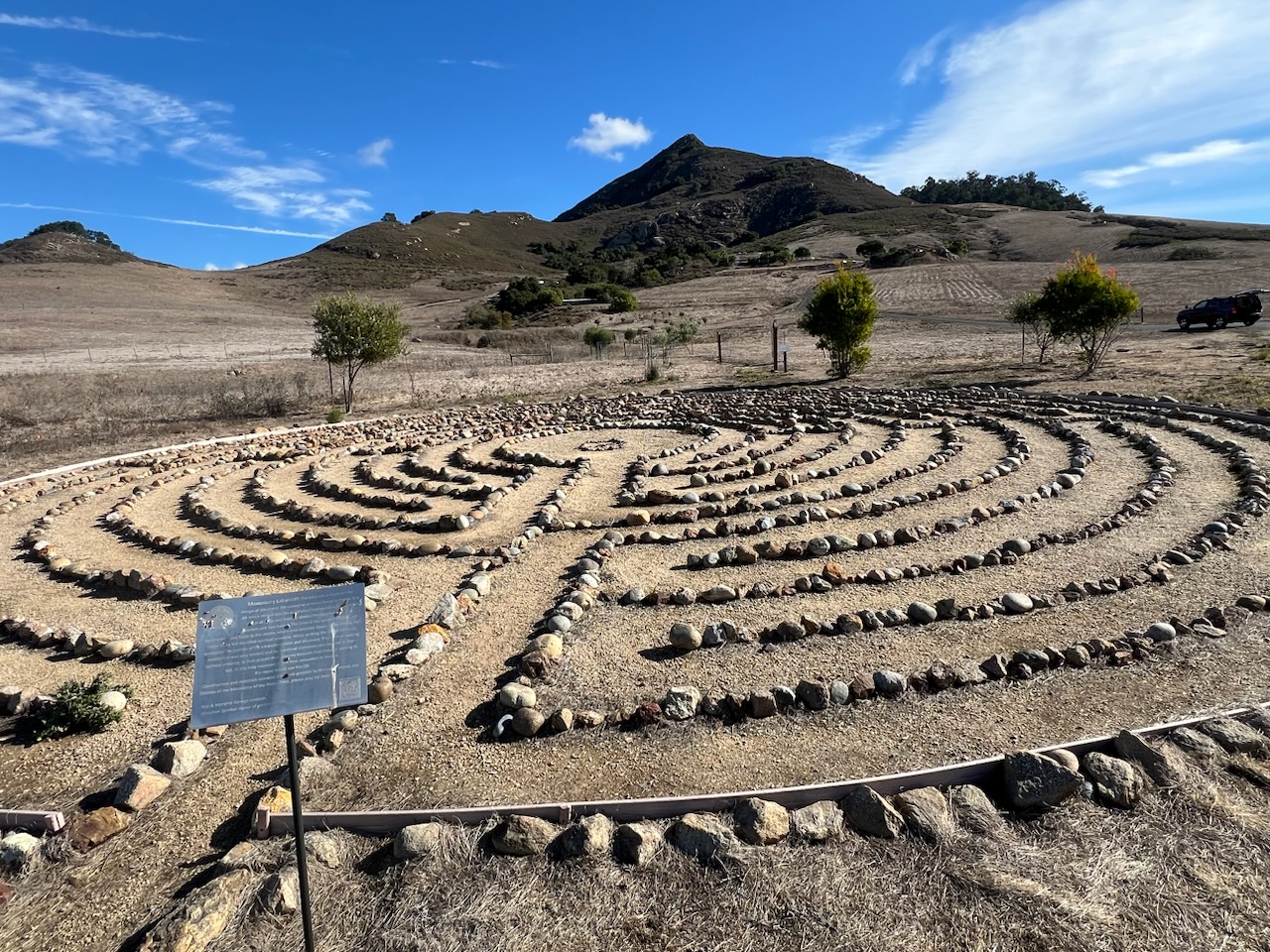
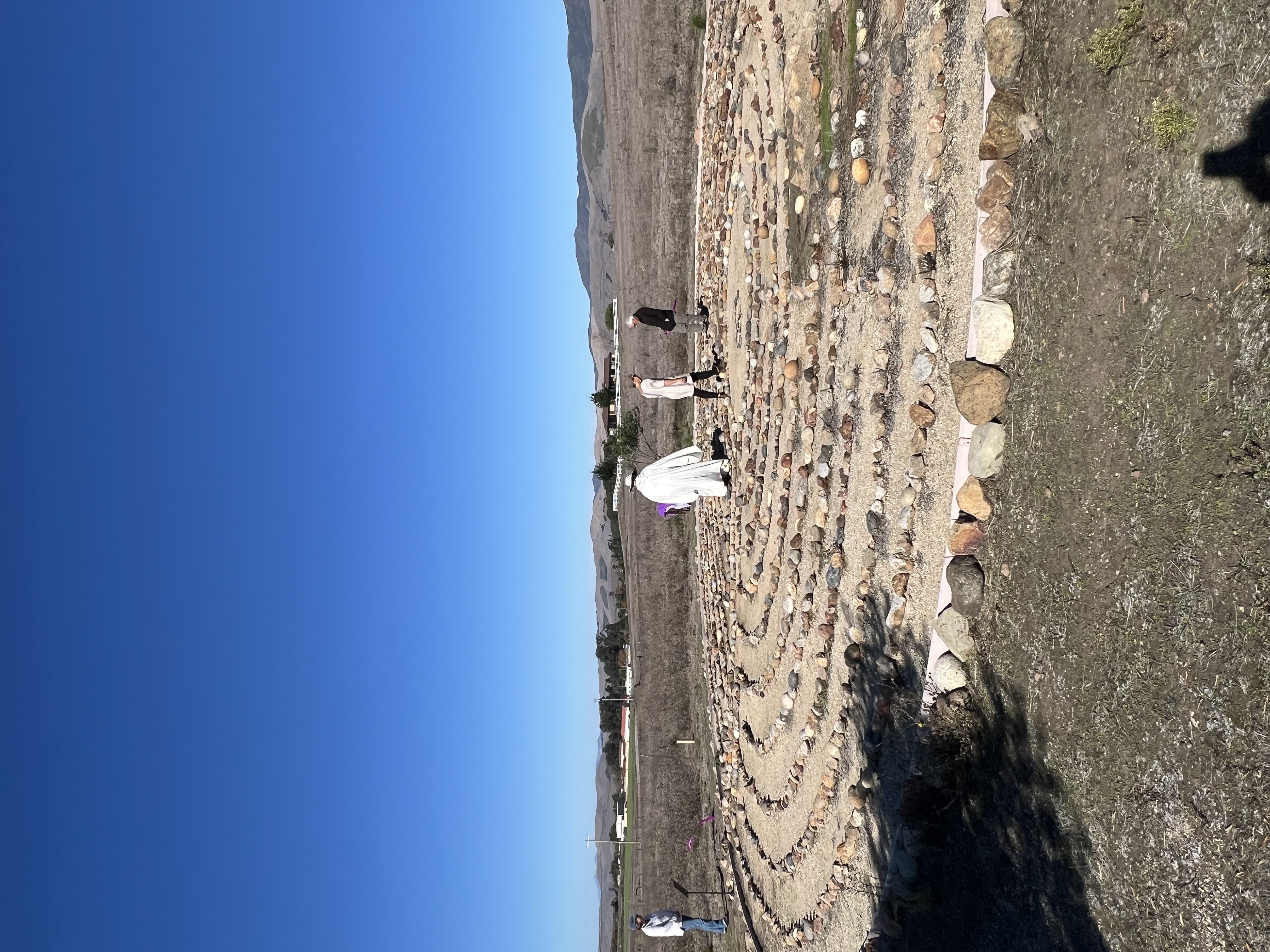
"The great Architect of the universe conceived and produced a being endowed with both natures, the visible and the invisible; God created the human being, bringing its body forth from the pre-existing matter which he animated with his own Spirit...thus is some way a new universe was born, small and great at the same time."(Gregory Nazianzen) While walking in meditation on the Labyrinth, under the shining Sun, with fellow woman and men, the sacred of each is a sign of the gift of peace. A peace dwelling within one another's heart where the Spirit of peace indwells yet moves our whole body to touch the earth that is our common home with every creature, in need of its blessings. Peace heals, unites and is the blessing of justice lived in compassionate empathy for one another. "Peace on earth and good will to all."

A number of years ago the author Aldous Huxley wrote: “Experience is not what happens to a person. It is what a person does with what happens to them.”
Meditating on the meaning of Thanksgiving Day certainly will conjure many memories in one’s life in America of the experiences that marked one’s life. For a Catholic the word thanksgiving is associated with the word Eucharist. Gratitude is a central meaning of many experiences that happen to one as the result the encounter of Eucharist from one’s first communion onwards in life. A life of humble gratitude is the result of the pervading real presence of Christ’s Eucharistic presence intimately woven in a person’s experience and indeed calls one to pay it forward in our relationships to others and indeed all of creation. Isaac of Nineveth in his Ascetic Treatises writes: “When God sees that in all purity of heart you are trusting in him more than in yourself. . .then a strength unknown to you will come and make its dwelling in you. And you will feel in all your senses the power of him who is with you.” Eucharist is the gift that has been given to bring this about within us and all of creation. The attitude of thanksgiving is to shape constantly an environment where compassion, justice render peace and joy in humble collaboration to keep callousness and cynicism from over coming us. Eucharist is a creative activity rendering one as a new creation in God’s future becoming our today. Thanksgiving Day can be yet another opportunity to begin anew with what happens to us as we enter in to it this year of 2024. “ The visible is the invisible written down. The Word, which produces, develops and attracts to itself every creature, is both silent and self-revelatory in it. It is silent in the negligence and greed of humanity. It is revelatory when humanity ‘names’ living things, like a poet on fire with love.” ( Olivier Clement, Roots of Christian Mysticism)
On behalf of our Camaldolese Monastic community and Oblates here at Monastery of the Risen Christ we pray you have Thanksgiving Day that renews your family and friends in hope.
The other day on the internet, I saw this cartoon. A patron was going into a library and he couldn't find the book that he was looking for. So he went to complain to the librarian. And the librarian says, "Oh, the apocalyptic section has been moved to current events." In one sense, we can laugh at that. But in another sense, there's a grain of truth there. Or as my friend Renee would say, "It's true, but not that true." So let's look during this homily at what might be a truer portrait.
Apocalyptic writing flourished in the two centuries before Jesus's birth. Under Alexander the Great, the Greeks conquered the then known world. Previous conquerors allowed the Jews to worship their own God, but the Greeks wanted their culture established throughout the whole Middle Eastern world. So the Seleucid king Antiochus Epiphanes openly persecuted Jews faithful to laws such as not eating pork in the second century before Christ. His proclamation is in the first chapter of the book of Maccabees. And when he desecrated the temple with the statue of Zeus, the Maccabean revolt broke out. An anonymous author wrote the book of Daniel that we heard from today to give faithful Jews hope of God's vindication and strength in the face of persecution.
Today's first reading answers the theological problem which Antiochus's persecution raised. What was the fate of the just and innocent Jews modered for keeping God's law?
The vision in Daniel 12 translates Israel's belief in God the Creator into belief that the same creator can awaken the dead. This passage is a radical vision of resurrection from the second century before Jesus. Fittingly, Christians often use this passage at funerals. Its imagery testifies to confident faith that the just pass into the care of God at death.
Communication is a two-edged sword. Communication brings constant threat into our living room. Weather extremes make climate change very believable. We plant earlier in spring and except in St. Louis Obispo, we sweat more in hotter summers. Rains come down in downpours that flood rivers and homes. lava flows in Hawaii make beautiful film footage long as one's house isn't in the way. We remember the hurricanes by name.
Today's gospel refers to natural desasters as trials that we suffer, not signs that the world is about to end. Mark's gospel refers to wars, earthquakes, and famines as birth pains, the labor of learning to love one another and create a community of peace on Earth.
Like us, the people for whom Mark wrote the first gospel knew about threat and loss. Jewish freedom fighters revolted against the Roman Empire in AD 66. Near the end of the four-year war, the Roman 10th Legion lay siege to Jerusalem. The soldiers surrounded the city for months to starve the citizens into surrender. When the Romans finally attacked, they destroyed the temple completely, leaving not a stone upon a stone. In destroying the temple, the Romans ended the ancient Jewish religion, its traditions of animal sacrifice. And so the synagogue took its place. Today, only the temple's Western wall survives, the holiest of sites for Jews where they daily gather to pray.
Today's gospel assumes an audience that experienced all of that. And that needs courage to face devastation and persecution. We contemporary Christians bring our own measure of worry as we become the audience of Mark 13. And many of us today are worried. Mark 13 is often called, quote, "the little apocalypse." Apocalyptic perceives the world locked in a catechismic struggle between the forces of good and evil.
In AD 70, shortly after the destruction of the temple, Mark wrote the first gospel for Christians unsure of what was coming to birth, unsure of themselves, of what was good, what was evil, unsure even of Jesus. Mark places the whole of the apocalyptic discourse in the mouth of Jesus as he sits on the Mount of Olives across the valley from the temple. Today's gospel contains two answers to the question of when Jesus will come again.
Some early Christians think Jesus will come again in their lifetimes. They insist Jesus promised, quote, "This generation will not pass away until all these things take place." Why is the gospel ambiguous about when the world will end? To answer that question, we have to understand what a gospel is and is not. People passed on Jesus's teaching orally for 40 years before Mark wrote it down. As people told Jesus's teachings and stories about Jesus, they not only passed on what Jesus said, they also used the stories to interpret current events in their lives and to answer questions he hadn't answered. Mark is writing in the wake of a cataclysmic event that demands interpretation, the destruction of the temple, which happened about 40 years after Jesus' death. It coincided with Jesus' eyewitness disciples reaching old age and with the deaths of Peter and Paul, who were martyred in the mid-60s shortly before Mark wrote.
Mark recognizes a second early Christian voice in his apocalyptic chapter. This voice does not say that Jesus is going to come again in our lifetime. This voice says, "Only God knows when the end will come." The signs of chaos Mark describes around us today--global warming, extinct plants and animals, persistent drought, oceans that teem with plastic. However, Jesus also gives us a positive image of sap rising in the fig tree and green leaves bursting forth. Indeed, we live in chaos. But what is chaos except a sign of something new emerging? What if the future is not scary but full of hope, every day a new creation? What signs of hope do we see? Perhaps it is the teen who is volunteering and finding his or her passion to serve. Maybe it's the person who always, always recycles and reuses. As Pope Francis mentioned, and I quoted in the introduction, it's the little details.
Ilya Delia, my former professor, is a Franciscan sister who writes on Christ in cosmology. In her book, The Emergent Christ, she encourages us to quote, "Allow the spirit to take hold of us and liberate us from fear, anxiety, and desire for power and control." We can live in the risen Christ who empowers us to participate in this new creation. God, the spirit will wake us up from our closed, perhaps mediocre, lives. The spirit lures us into openness to new life and lures us into finding hope.
Diana McElintol, a liturgist who often comments on the Sunday readings, summarized today's gospel in this short phrase. Third verse, the same as the first.
One of the great challenges of spiritual maturity is sorting out the meaning between intentions and results in your life. We’re all struggling with that. We all have good intentions about a lot of things. The electorate had that. Good intentions were given to many people, and completely different results have happened. When that happens in your life on any personal, collective, or whatever issue, the challenge illustrates that there’s also a margin we must pay attention to, called freedom. This freedom is experienced very really, but we also admit to ourselves that our notion of what we think freedom is is sometimes very limited. We only understand the measure of its impact on our lives or others in degrees as we make a journey or the pilgrimage of life, as we call it in spirituality.
An author, Alistair McIntyre, wrote a book called Stories many years ago. He illustrated in that book that the people who are all of us are about doing a co-narrative about our lives all our life long. It’s a co-narrative because the narrative is intersected by many things out of our control or unforeseen things that we couldn’t even imagine would occur in our lifetime. This narrative we co-author as we write our own story causes us to experience causes, effects, choices, chances, and how they emerge in our lives. Also, it calls us to make a decision on how much value we place in them as something really substantive and calling us, especially as Christians, to our willingness to allow God providentially to guide and aid us at all times because we’ve come to believe that the words of Jesus, “Behold, I am with you all days until the end of the world.” But when you experience this challenge between intentions and results, you may find that your ability to freely believe is lacking.
It was so much lacking at the time when Sigmund Freud was alive. He wrote a letter to Mrs. Maria Bonaparte. She wasn’t kin to Napoleon. But she had inquired with him about the meaning of life. His letter and response to her began to stamp the late 18th and early 19th century and beyond, even to her own time. In his response, he told her, “To hope of finding meaning and value in life is insane.” Thus, he abandoned humankind’s approach to a meaningful world and said it was meaningless. Later, he would say in the following sentence, “It’s a meaningless world.” This observation was made by another author, Philip Reif, who wrote The Triumph of the Therapeutic. I don’t know if you’ve ever read that, but it’s a powerful book. Philip Reif wrote back in the early 20th century. However, it affected us as a Western society because we put a lot of counsel into Freud rather than Jung and others who followed him. So you can see here’s a very lettered European who is well-studied in human behavior and things like that as a life scientist. But still ending up with a very empty perspective.
Interestingly, parallels were selected here when we think of this passage from the Gospel today and about the prophet who comes to another widow. But it’s important to remember that when we think of miracles, I was told by a Jesuit scholar years ago in Europe that we were studying some sacred scripture in the Old Testament and knew. He remarked, “Remember that,” and used this passage from Mark and Isaiah. He said, “Remember that miracles are something you participate in. You have to bring something to the table, and then you’ve got to let it go to God and let God providentially deal with it.” But it’s always a cooperative effort and never like magic. Many people, and all of us, can find in our lives that sometimes we want more magic because magic puts us in egocentric control. God and gods or fairies or whatever will do what I want. That’s the bottom line of magic, to do what you want. It doesn’t matter whether black or white magic; it all ends up in the ego. Eosentrism, as we call it. But with the mystery of miracle, because we believe in a participatory God who is in relation to the creation, relationship, and relationship to us in the Judeo-Christian belief, is that God is not any further away than the end of your nose and actually beyond your nose into your lungs and everything else. But God always humbly approaches us with great humility and respect about how we and how the wonder of life and all the visages of things that evolve in one’s life, how we’re going to walk with God’s presence and at the same time walk in trust, but also find the celebration and the wonder and the capacity to live a full life whether it’s in tragedy or in beauty, wonder, and triumph. It’s there where that transcendent experience of God’s relationship of love, which would be another word for grace, affects us, but yet doesn’t abandon us to do it alone but at the same time upholds what we can be and what we can become by doing the grace within ourselves and for others, you might say.
Life is sort of like a tree; you’ve probably heard this expression; if you look at the rings of aging in a tree, it’s an interesting metaphor for human life because they are recorded for a tree that a tree has to stay in place all its life, it doesn’t get up and walk around like a token. Still, the important thing is that the tree has to weather so many changes beyond its power to have life. It’s one of the oldest species on the earth outside of insects, incidentally, in the evolutionary scale of things. You see a downed tree or something like that, and you can read it when you think of it. Scientists do this now they read whether there were more diseases, more drought, more winters, and so forth, and the further study is how the tree adapted, how the tree experienced this, and what was the result of how it continues to stay in place and be alive and still self-giving both in its root systems and in its branches and leaves to so many other creatures of this planet. So it causes us to think that one of the aspects of a miracle is to create alterations, that God can inspire us in such a way as to make alterations in our lives.
Now, the woman who is the widow in the story of the prophet is making an alteration when the prophet comes on the scene. She does the courtesy of her faith, which was when a stranger came, you offered them what you had. They came by your household as if it were water or anything like that because the ancient belief in Israel was you might be entertaining an angel, and that’s still persistent in Bedouin practice in Egypt if you ever go there. And so there was this firm belief that a favor would be granted. It all goes back to Abraham, you know. The three mysterious strangers show up and prophesy that Sarah will be pregnant the next time they come around. Of course, both he and Sarah are in disbelief at this. Still, you watch the actions of Abraham. In that case, he participates in the miracle that will happen to Sarah. Sarah also participates even though she laughs in the tent at this ridiculous prophecy these three strangers give. This same storyline comes to us in the first reading, but the widow is at the end of her rope. You know she’s been surviving famine with her son. She’s a widow, and she’s a woman. She has no economy other than the jewelry she might have had. It’s perhaps all that was in the gone because all she’s got left is a few sticks, a fire, and a little flour and oil to make a cake. Then she knows that her son is going to die, and she’s going to die of starvation, too. But what she does is she participates in this mysterious utterance of this prophecy by faith and she gives the little that she has which was to survive just maybe another few days and give this to the stranger hoping for a blessing and of course miraculously we’re told that she’s it’s prophesied to her that you know the flowers not going to run out and the oil is not going to run out you know and then you see Jesus claiming and affirming this type of response because the widow comes to the treasury she’s not expecting anything back but she’s very faithful but she uses it very much to illustrate to his disciples what it really means to give from the substance of your life and allow a pathway for Providence to really demonstrate for you how close and how wonderful it is and here you have Jesus symbolically more than symbolically looking into her heart and life and seeing the depth of which God really treasures this great woman who actually lives and mirrors back to Jesus what it’s going to cost him on the cross he’s going to have to give not from the excesses of his life and ability he’s going to have to give out of the absolute essence of himself and give it away entirely in death for a greater miracle to save the human race for all ages and the universe so he’s seeing him there a prophecy coming through her and he’s affirming that prophecy to others that will have to follow this same way.
Saint John Paul II wrote in encyclical some years back before his passing about the economy and I think it was and I can’t remember the Latin term right off hand pardon me but in there he said to the world and especially the church he said God has called you to give not merely from your surplus but from the substance of your life and he was calling the church to take a risk a significant risk to divest itself in such a way as to help the poor of the nations and that every opportunity that we have as a disciple if we’re really wanting a miracle we open ourselves to that Providence that says I can trust God and I can do for that for another person that which I would hope if I were in their shoes would be done for me and celebrate that as a actual miracle of God’s Providence with us see a lot of times when we look at miracles we we want to see bright lights and fireworks and everything around it but miracles that I have witnessed a lot of times in life are much much much more subtle than that because it’s involved with the transformation of a human person’s not in so much sometimes that it can transform everything about the situation that they’re in but something really divine something beautiful something like Mother Teresa had said do something beautiful for God that was her response do something beautiful for God because God’s given you the power to do that to act like God in behalf of another.
I remember I think I told you this story but I’ll repeat it just because I think it’s a good thing to for me if not for you I was in Honduras and during the Nicaraguan Revolution and this I’d gone three days on horseback to with another priest to visit this village that hadn’t seen a priest in over two years and they were all indigenous people they lived on this one mountain they had their own language and everything wonderful people and they were entirely Catholic and so we went there and the moment that I got there I got off my horse and the horse had stepped into a big anthill and they were those soldier ants you know kind of thing so they’re not fun to play with and the horse started jumping as I was trying to get my toe out of the stirrup and I fell to the ground and of course the horse was kicking and ran off and and then father Michael came over in the two vocaros and said are you okay and then the ants were just pouring out of there like this red blood stream and all of a sudden this little boy who is about probably about two about three years ago just learned to walk I would think he steps on his father’s machete and cuts his foot in half all the way up to the bone blood flowing everywhere and you got the red ants and one thing you’ve got this little boy bleeding and turning white and we only had band-aids and some gauze and some you know antiseptic cream so I ran over to him his mother was hysterical she had been trying to fix food some tortillas for us and so there she is blood all over in front of her and so I started holding his foot together as I knelt before him and his little sister who was about six years old was standing there watching all this and I knew that it felt like as much as I was praying it felt like I felt extremely powerless nothing to do and the other than do what I could which was to comfort and bandage the foot together and do what I could do and put a tourniquet but not so tightly so after doing that I walk off and I thought I’m just I just need to clear my head so I walked down towards this little stream that ran below the village and this little girl her shadow I saw her shadow beside me and she came up and took my hand and we sat down by the stream together and she had she had a little tangerine beautiful golden tangerine in her hand and she looked up at me as I was staring at both of our faces in the stream and she put the tangerine in my hand and I wrote a poem called the little the girl with son in her hand the importance of this was the widow’s might because at that time all the produce that was being produced for General Foods Corporation and Dole the best fruit was being shipped off to the country and the people of Honduras always had the poorest of anything that was left but a tangerine for a little five-year-old girl was like having a banquet and she gave her back with away to me and that’s when I learned to the meaning of this passage these two passages give a mere substance as St. John Paul II said and that kept ringing you know over this lifetime that I’ve had and it and it really started me an understanding that we have to have a passionate knowledge and that’s what happened in the heart and spirit of this little girl in the middle of that village on the mountain in Honduras years ago she had a passionate knowledge gifted to her by God of what God would do and she was only five years old couldn’t read and write but if she were she was a saint in my estimation.
Life can be read like rings even in a small tree even a tree that’s just a sapling has a story to tell us so we never put her until total emphasis on just what we can do but also what God will do within us and give us the power to do even in our limitations they’re sobering treks for us all ahead but isn’t a pilgrimage in faith that in truth you know the way we used to say we used to talk about journey I think was Joseph Campbell who said one time that the word journey really came from the land the distance you could travel in one day and maybe we only have one day but one day as the scriptures tells us is one day in God’s imagination is like a thousand lifetimes or a thousand years and and you often hear in our culture are we there yet most of its derogative are science to its impatience are marginalized as people that we might be around are their intelligence of their abilities are we there yet imagine a teacher or professor saying that to you and you’re trying to learn but imagine that on a spiritual level and if I’m carrying that kind of attitude with the very energy that I could turn to love and support and say we’re on a journey together but you just need my help and I need yours pilgrimage is often bring us to very different different destinations at times but the destination the closer we get to it all of a sudden we realize another destinations even further grace is that mystery of working in our lives the destination that God has already revealed but it is not without its challenges not without its struggle not without asking of us give the substance of your heart whatever that mean means for you and your conscience and from that will flower you know a new creation intentions are definitely to be discerned as opposed to the results we expect and I’m sure that little girl who I hope grew up to a womanhood and the fullness of her life is still putting a piece of Sun in the world and in the hearts of others.
Once again in the Easter season reflection on tangible and in-tangible presence of the resurrected Jesus envelops our Christian imagination and informs our day to day meditation and practice of gospel living. Saint John’s gospel occupation with ‘Light’ and ‘Bread’ experiences within his community post the resurrection event sets out a dynamic activity of Christ Jesus amidst their’s and our journey toward the fullness of life and joy. The nurturing care of Christ displayed in the warmth of light and bread characterizes how we can and need to locate our relationship to Him and one another in this world. Much popular secular imagination has emerged in the search for the Holy Grail, a legend defined in the Grail lore of the early middle ages in the Arthurian legend. Yet, missed in the search for this object, the cup used at the last supper is disconnected from the on-going presence of the Eucharist at the Mass celebrated in eastern and western churches the world over. The grail in popular imagination is an object like some sort of talisman an object of intervention one could use, without an co-responsibility of relationship for others, as the one who is Bread of Life modeled responsibility at the Last Supper in St. John’s Gospel. The washing of feet, was the tender and caring, nurturing development that the Grail-Bread empowers within a disciple’s life of compassionate actions. Saint Peter, who at first refused to have his feet washed by Jesus, is taught on the spot, that to have a place of relationship with Jesus is to allow Jesus to first display his care of mercy toward him. So, a deduction can be made that the drinking and eating of the Grail-Bread attaches us to the very ministry of Jesus in our own sphere of influences as disciples. Mercy, savoring, fellowship of belonging responsibility for our neighbor calls each to be about the activity of the Good Samaritan. To be in relationship with Jesus, the ‘Bread of Life’ is to participate in becoming that same presence ratifying in our behaviors its everlasting truth. The Eastering effect is circulating in our world of today, in the ordinary and extraordinary witness of the disciples by the grace given. Every activity that plays forward the compassion, mercy, joy and savoring of the good of God in people, creation is a sign and condition for all of us to keep the vigil of heart for sake of our world’s future transformation into its own resurrection.